When science, education, and a love of the outdoors come together, it could only be the Trinity of teen trips: Ascend's 2026 Teen Science Trip. More than a year in the making, this unique wilderness experience brought together an extraordinary team of scientists, from zoologists/entomologists to botanists, biologists, and lichenologists, creating the ultimate cornucopia of scientific discovery in the heart of Trinity County.
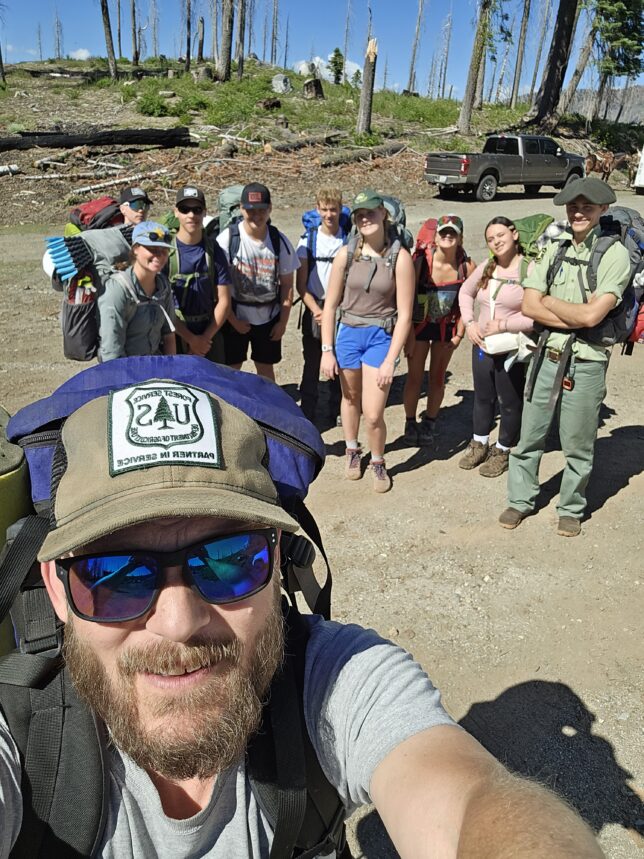
From the moment the pack meeting began on July 5th, excitement was all over the teens' faces. They were eager to hit the trail and immerse themselves in a week of discovery, learning about amphibians, insects, local flora, and lichen in the wild places they call home. First, however, came the minutiae and practicalities. Communal gear was distributed, backpacks were packed, final questions were answered, and everyone headed home for one last night's sleep before the adventure truly began.


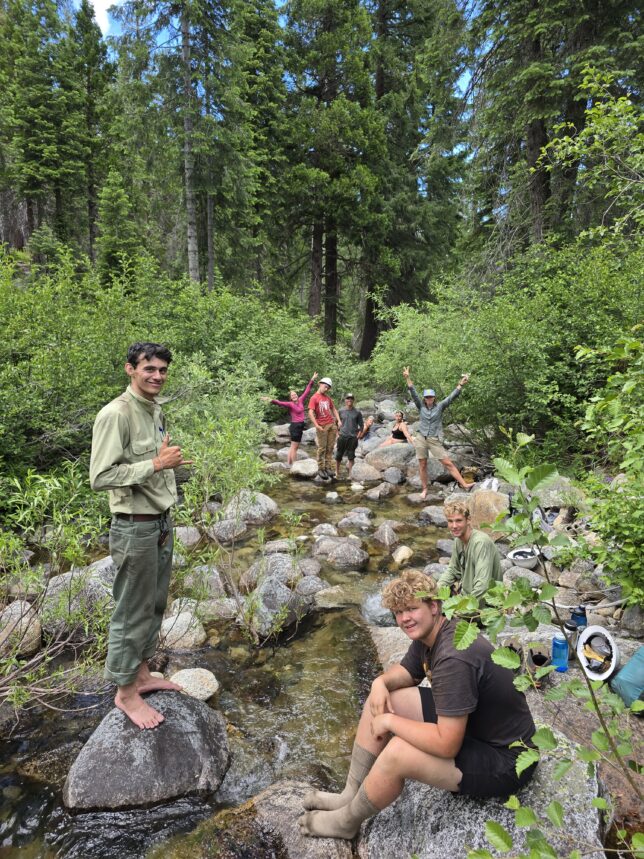
July 6th dawned bright and early. Everyone arrived with backpacks ready and gear in hand. The group loaded into the Ascend van and headed north on Highway 3 toward the Deadfall Lakes, where they would spend the next five days camped in the shadow of Mt. Eddy. Upon arriving at the trailhead, the group's excitement was thicker than the incense cedars lining the trail to the lakes. Waiting to greet them was Jared Dunham, lead entomologist with The Beneficial Insectary in Redding. Armed with his bug net and an encyclopedic wealth of knowledge that flowed as freely as a mountain stream, Jared immediately set the tone for the week. The ambition to get up the trail, establish camp, swim, learn, and immerse themselves in life beyond the bubble of technology was palpable. It almost felt like a race to see who could leave civilization behind the fastest. After arriving at Middle Deadfall Lake, the group selected a campsite on the far end of the lake. With a large and enthusiastic crew, it offered plenty of room while minimizing disturbance to other wilderness visitors, a reminder that stewardship begins with how we share wild places. Once camp was established, everyone cooled off with a swim, enjoyed lunch, and began planning the days ahead. Joining the trip were two undergraduate biology students, Rowan and Landon and two graduate botany students from Cal Poly Humboldt, Annie and Jenni, all eager to share their knowledge and spark curiosity about the remarkable flora and fauna of the Klamath Mountains. That afternoon, Jared unpacked his portable microscope along with a fascinating assortment of insects for everyone to examine. The teens were instantly captivated. Before long, insect traps were placed throughout camp in hopes of capturing the night's tiny wanderers, and a large white sheet illuminated by black lights was stretched between two trees to attract nocturnal insects after dusk. The first day could only be described as a success. Countless facts were shared, questions came without end, and the teens absorbed every lesson like sponges. As dinner filled hungry stomachs and darkness settled over the lake, everyone played group games, then thoughts naturally drifted toward what tomorrow would bring from their sleeping bags.


July 7th began early as camp stirred to life. Water was gathered, breakfast prepared, and Jared helped the teens collect their tiny nocturnal wanderers before comparing and identifying the previous night's discoveries. Before long, it was time to say goodbye to our zoologist/entomologist and make the short trek to Upper Deadfall Lake. Waiting there was Justin Garwood, a fisheries biologist specializing in herpetology with the California Department of Fish and Wildlife, along with three fellow biologists. The teens were introduced to the team and quickly immersed in one of the Klamath Mountains' most fascinating conservation stories: why non-native brook trout now inhabit many of the region's lakes, how their introduction dramatically altered habitat for the Cascades frog, and what is being done to restore these fragile ecosystems. To date, fewer than two dozen lakes throughout the greater Klamath region have undergone brook trout removal, with remarkable results. Upper Deadfall Lake serves as one such success story. In 2023, surveys found no Cascades frogs in the lake while brook trout were still present. Fish removal efforts began that same year and continued through 2026 until the lake was free of non-native trout. The group split into four smaller teams, each led by one of Justin's biologists. Every team was assigned a different pond, meadow, or wetland to survey for Cascades frogs, salamanders, toads, snakes, other amphibians, and any remaining fish. The teens quickly became field biologists, carefully searching suitable habitat, recording observations, and learning firsthand how wildlife surveys are conducted. By the end of the morning, the teams had documented 13 Cascades frogs along with numerous tadpoles, a promising sign that the population is rebounding following the trout removal. One survey site proved to be a hotspot for garter snakes, while the others revealed encouraging signs that frogs and other amphibians were recolonizing the surrounding wetlands. Justin explained how these connected habitats allow wildlife to disperse naturally, helping maintain healthy and resilient populations across the landscape. After lunch, the group moved on to the day's final project: tagging Cascades frogs for future monitoring. The biologists carefully implanted identification tags in half a dozen frogs while the teens gathered around in quiet anticipation, watching each step of the process. One individual measured an impressive 79 millimeters, making it nearly record-sized for the species. Once the frogs were safely released back into their habitat, the discussions continued as the group made its way back to camp. The afternoon gave way to swimming, relaxed conversation, and a well-earned dinner. Just before sunset, Dr. Eric Peterson arrived at camp. A published lichenologist who now works in river ecology with the Trinity River Restoration Program, his role in the week's scientific journey would unfold the following morning. Before long, stars filled the sky above Mt. Eddy, games were played, and one by one the teens drifted off to sleep, eager for whatever discoveries tomorrow might bring.


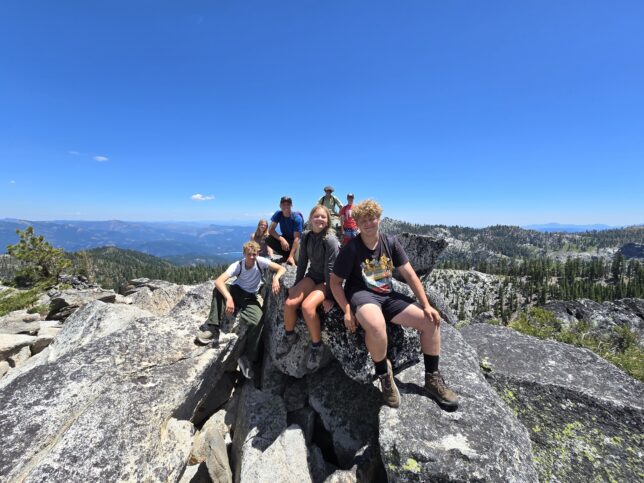
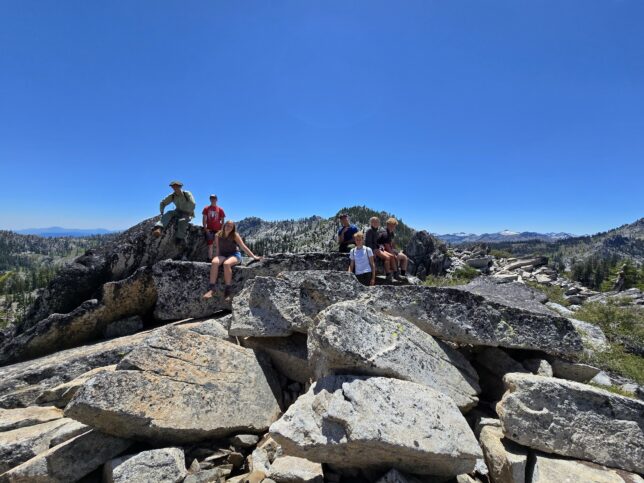
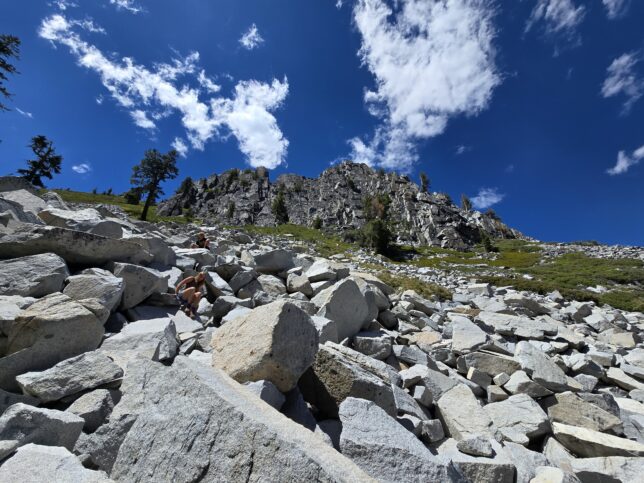
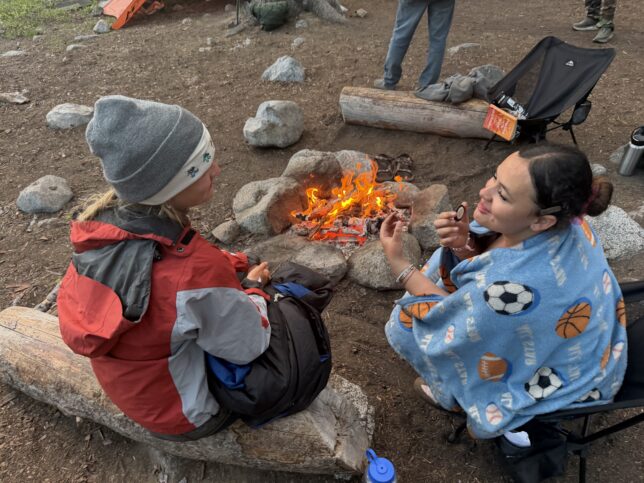
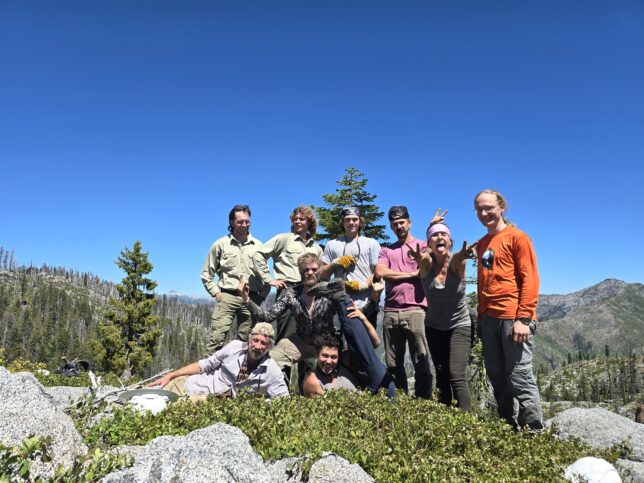
July 8th. Water, breakfast, and conversation filled with curiosity and laughter. By now, camp had settled into a comfortable rhythm, and everyone knew what the day would bring. With Dr. Eric Peterson joining the group, curiosity naturally turned toward a simple question: What is a lichen? The answer, in its simplest form, was that a lichen is a partnership between a fungus and an alga, living together in a remarkable symbiotic relationship. With a very basic understanding of what a lichen is, Dr. Eric let everyone know that they would be summiting Mt. Eddy to study high-elevation lichens, to observe rare alpine plants, and to revisit a long-term project that he had begun years earlier–mapping the size and growth of a fox tail pine near the summit. As the group climbed higher, the mountain became an outdoor classroom. Rare trees and wildflowers were pointed out along the trail, including the whitebark pine, whose seeds are dispersed almost exclusively by the industrious Clark's nutcracker, and the Siskiyou fireweed, despite its name, it is not a true fireweed. Upon reaching the summit, the views captivated everyone. Mt. Shasta dominated the northern horizon, while the Trinity Alps, the Russian Wilderness, and the Marble Mountains stretched away in the West from North to South. A few stubborn patches of snow still clung to the summit, and, in true teenage fashion, several of them mixed snow with the last of their electrolyte packets to make improvised snow cones. Surprisingly, they were pretty good. With Dr. Eric's classroom now fully assembled, he gathered several lichen specimens while the rest of the group explored the summit and rested among the remnants of the long-abandoned fire lookout. Hand lenses and samples were passed around as discussions turned to lichen anatomy, how the fungal and algal partners function together, and how these remarkable organisms survive in one of the harshest environments imaginable at the top of an exposed 9,000-foot mountain. A group photo soon followed before botanists Annie and Jenni led everyone to another remarkable discovery: the Mt. Eddy sky pilot, a rare subspecies of Polemonium found only on and around the summit of Mt. Eddy. Its delicate purple blooms were quite the juxtaposition to the seemingly inhospitable granite landscape surrounding them.From there, the group descended roughly 1,000 feet to the foxtail pine Dr. Eric had come to revisit. There, Jenny explained that her research focuses on the mountain's two dominant high-elevation conifers: the whitebark pine and the foxtail pine. She shared that Mt. Eddy supports the largest grove of foxtail pines in the Klamath Mountains, while a separate subspecies inhabits the highest elevations of the Sierra Nevada. Her work involves monitoring these ancient trees for disease, drought stress, and bark beetle activity, and she spoke passionately about both the trees themselves and the rugged environments they call home.After an engaging discussion beneath the foxtails, the group continued down to Upper Deadfall Lake for one final lesson of the day. There, Annie, an expert in wetland meadows degradation, introduced everyone to Nuttall's quillwort, an unusual aquatic plant that lives entirely submerged and represents one of the oldest surviving lineages of vascular plants, having changed remarkably little over hundreds of millions of years. Its unassuming appearance belies an extraordinary evolutionary history. Returning to camp, the evening concluded with an informal roundtable discussion between the scientists, guides, and teens. Questions ranged from education and career paths to the rewards and challenges of working in the natural sciences. The conversations became surprisingly personal and thoughtful, revealing not only what it takes to become a scientist but why each of them had chosen that path. The discussion was so engaging that everyone agreed it deserved a second roundtable the following evening. As it got darker, games were played, the teens got sleepier, and dreams were had.


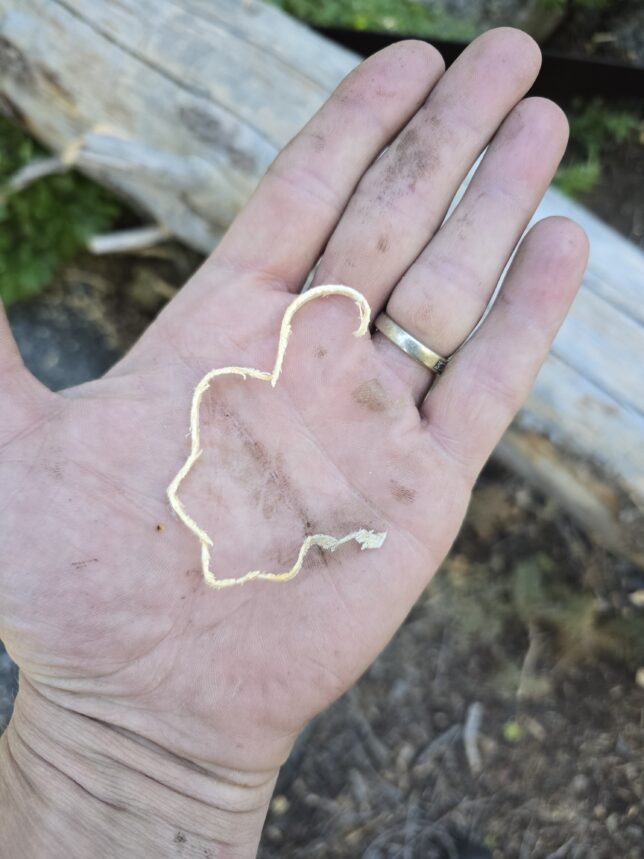
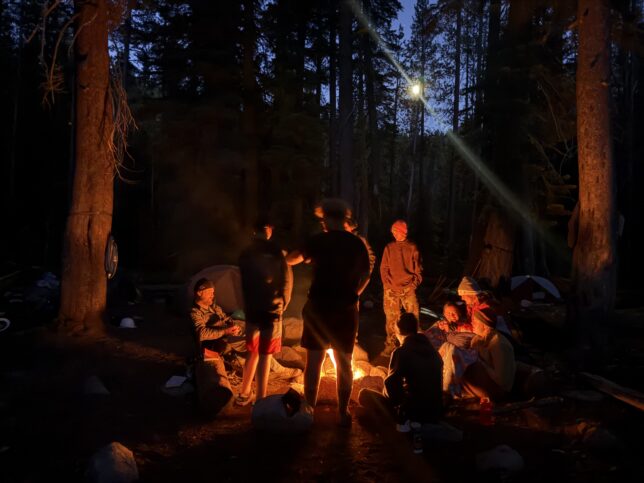
July 9th. The routine was so regular it was happening on autopilot; water, breakfast, and readiness for the day.Before departing, however, he wanted to share one final treasure with the group: the current California champion curl-leaf mountain mahogany growing just off the Pacific Crest Trail. The group headed down the trail to the junction of the PCT before arriving at the remarkable tree. Once everyone surrounded the tree with curiosity and inquiries, the discussion began: Dr. Eric explained that the tree had been nominated as California's champion in 2020 by Michael Kauffmann, noted local author, botanist, and longtime friend of Ascend. But the tree's significance didn't end with its impressive size. Growing quietly upon its branches was one of California's rarest lichens: Stenocybe procrastinata. First described by Dr. Eric himself, the species, earned its name from the extraordinarily long process required to formally describe and publish it, a process that stretched well over a decade. Until that morning, only a handful of people had ever seen the lichen in person. In just a few minutes, thanks to the curiosity of an eager group of teens, that number had nearly doubled. Dr. Eric was ready to depart and Annie was ready to take the group to a meadow to show them another special plant; Darlingtonia californica–the California pitcher plant, Annie’s forte. The show wasn’t just about the pitcher plant, there was another carnivorous plant nearby; Triantha occidentalis or the western false asphodel. With both carnivorous plants in-hand, the show and tell began with Annie cutting open an older withering pitcher plant to show the teens all the accumulated bug parts in the base of the stem, explained how the bugs get trapped inside, and she also showed them the flowering part of the pitcher plant.The asphodel’s unusual carnivorous feeding strategy differed and was only discovered in 2021, in that it has sticky glandular hairs on its stem and draws small insects to get stuck there so that they can be absorbed by the plant’s enzymes. Just as the group prepared to return to the lake for lunch, an unexpected opportunity presented itself. Passing through the area was Dr. Laura Levy, a geology professor at Cal Poly Humboldt specializing in glacial geology and sedimentology. Recognizing Annie and Jenni, she gladly accepted an invitation to speak with the teens about the remarkable landscape surrounding them. Standing among the granite basins of the Deadfall Lakes, Dr. Levy transported the group back through more than 400 million years of geologic history, explaining the repeated advance and retreat of glaciers, the uplift of mountain ranges, and the ancient forests that have come and gone across the landscape through deep time. What began as an impromptu conversation evolved into nearly an hour of captivating storytelling that left everyone looking at the mountains through a completely different lens. After lunch, Annie and Jenny introduced the teens to one final field exercise. In a large flowering meadow near the lake, the group conducted a botanical relevé—a scientific vegetation survey used to document plant diversity and abundance. The teens identified species, estimated vegetation cover, recorded observations, and carefully pressed representative specimens that would later become part of Cal Poly Humboldt's herbarium collection. Throughout the exercise, Annie and Jenny patiently explained each species, transforming what might have seemed like an ordinary meadow into a living catalogue of botanical diversity. With the day's science complete, everyone returned to camp for an afternoon swim, dinner, and one final evening together. The second roundtable discussion naturally followed, with conversations once again drifting from careers and education to life itself. Group games, laughter, and stories carried on well into the evening. This night was different. Knowing it was the final night in the wilderness gave every conversation a little more meaning. Nobody seemed eager to crawl into their sleeping bags. The thought of leaving hung quietly over camp, tempered only by the friendships that had been built and the experiences that would soon become memories. Civilization waited on the other side of morning, but for one last night, the stars above Mt. Eddy belonged entirely to the group.


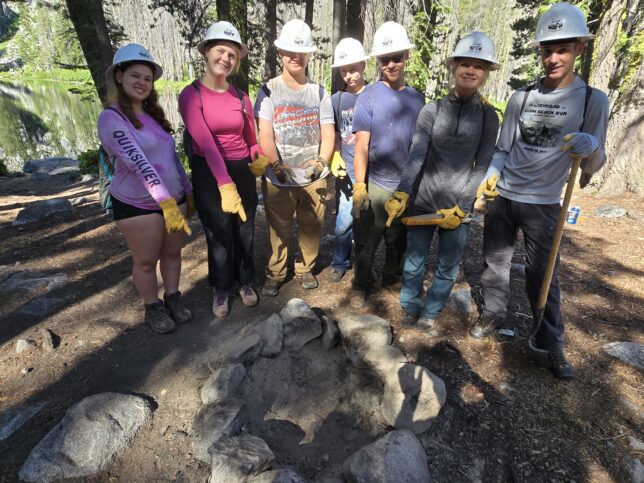
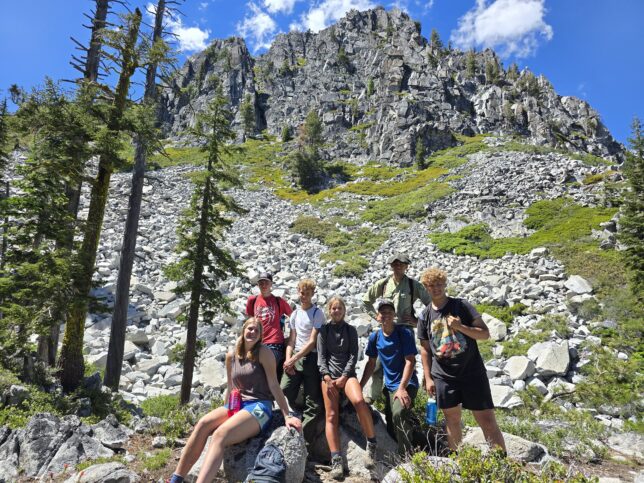
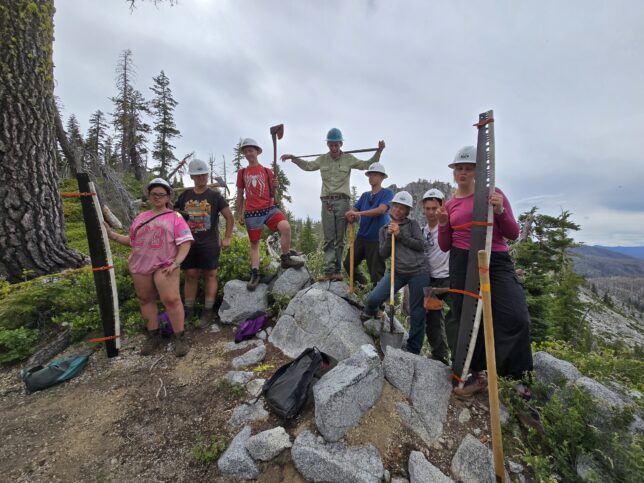
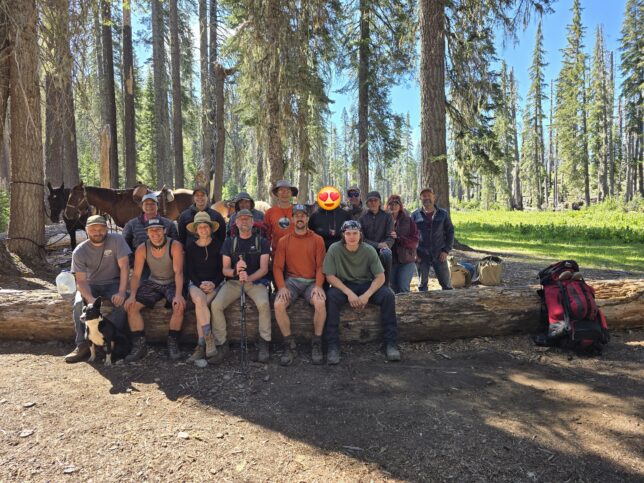
July 10th. The routine unfolded, but this time it was different, it involved packing everything up, packing gear, taking down tents, and dividing up communal items. Reality had set in; the adventure was coming to an end. Once camp was ready to head out, everyone bombed down the trail. I don’t think it even took 45 minutes to get back to the trailhead. With the van loaded, goodbyes to Annie, Jenni, Rowan, and Landon complete, a group photo was in order as a small celebration marking a week well spent. Soon everyone went their separate ways while the teens and guides, Andrew and Zach, made the drive back to Weaverville. Gear was cleaned and put away, followed by the traditional reward of hot sandwiches and ice cream before parents arrived to take their teens home.
The science adventure had come to an end, but something far more important had begun. New friendships had been forged, curiosity had been ignited, and a deeper appreciation for the natural world had taken root. The mountains of Trinity County had once again done what they have always done best: teach those willing to slow down, observe, and wonder. The trip was over, but the memories and perhaps the inspiration for a future scientist or steward of the land, will last a lifetime.